
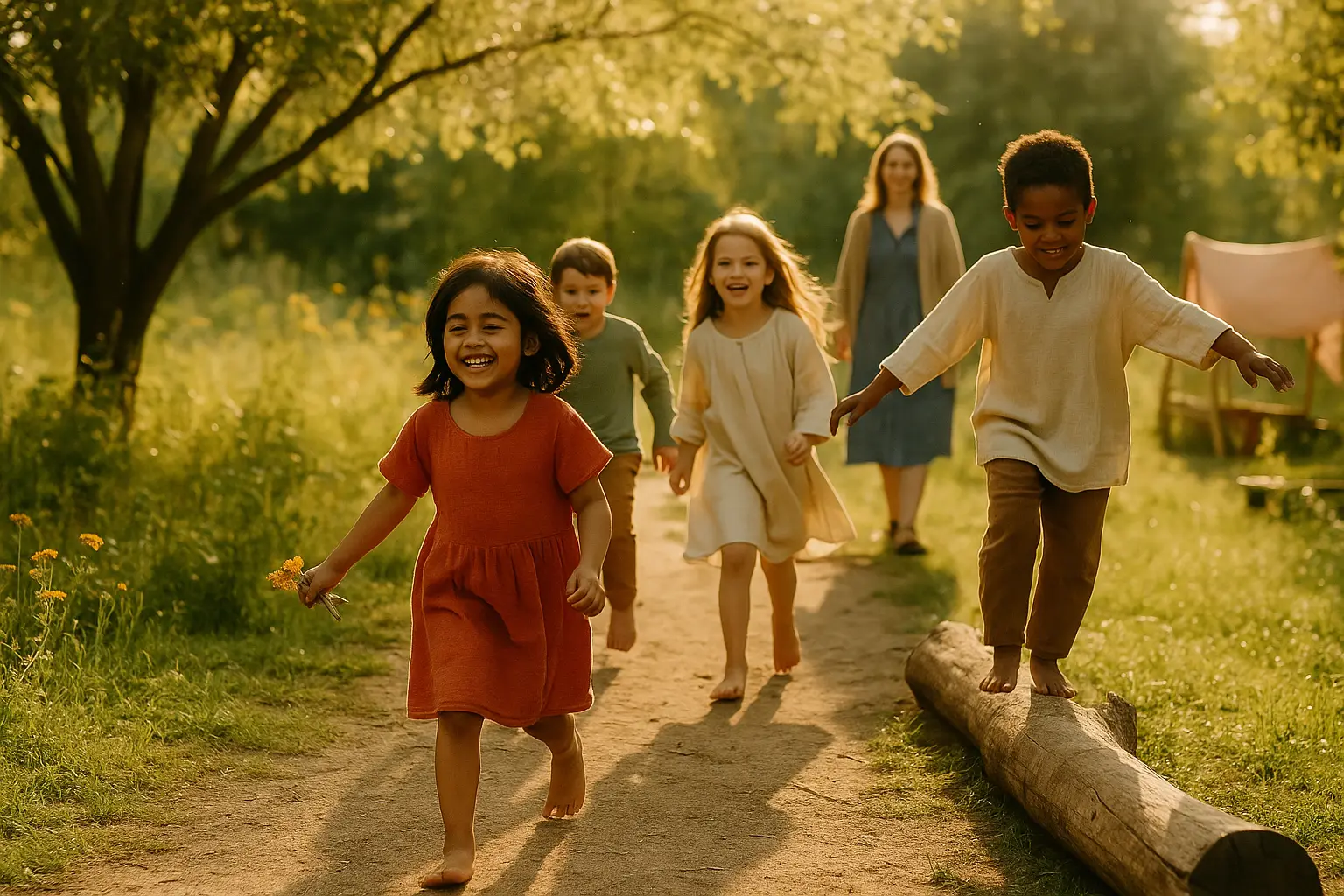
School’s Out, Holiday’s In
A Waldorf Guide to Meaningful School Holidays

The arrival of the school holidays often brings mixed emotions for parents. While children eagerly anticipate days free from school routines, many adults begin wondering how to fill the weeks ahead with enough activities to keep everyone happy.
At Straits Waldorf School, we see the holidays a little differently.
The school break is not a time to entertain children every waking moment. Instead, it is a precious opportunity for families to slow down, reconnect, and allow childhood to unfold naturally. Sometimes, the most meaningful holidays are not the busiest but the simplest ones!
The Gift of Rhythm
During the school term, children experience a familiar flow to each day. They instinctively know what comes next! Morning greetings, artistic work, outdoor play, snack, stories, shared meals, and rest. Long before they learn to tell time, this dependable sequence becomes part of their inner world.
The holidays need not abandon this comforting rhythm.
Simple, predictable patterns at home like regular mealtimes, outdoor play, quiet afternoons, family dinners, and early bedtimes that provide children with the same sense of stability they experience at school. A gentle rhythm allows children to relax because they know what to expect.
Book a School Tour to discover how Straits Waldorf School can provide your child with an education that nurtures their head, heart, and hands.
The Beauty of Repetition
Modern life often convinces us that children need constant novelty to stay engaged. In reality, the opposite is often true.
Children delight in returning to the same playground, climbing the same tree, building with the same blocks, or hearing the same story night after night. What appears repetitive to adults is, for a child, an opportunity to deepen imagination.
A park bench becomes a pirate ship one day and a castle the next. The same collection of wooden blocks transforms into an airport, a bakery, or an enchanted forest.
Repetition nourishes creativity because it gives children the freedom to invent rather than consume.
Rather than searching for a different activity every day, consider allowing your child to return to familiar places and familiar play. You may be surprised by the richness that emerges.
Breathing Through the Day
One of the beautiful principles in Waldorf education is the rhythm of the “in-breath” and “out-breath.” An in-breath is a quiet, inward activity that invites calm and concentration. This may include:
- Listening to a story
- Drawing or painting
- Baking together
- Mealtimes
- Rest or quiet reading
An out-breath is an active, expressive experience that engages the child with the world. Examples include:
- Free outdoor play
- Building forts
- Running, climbing and exploring
- Gardening
- Playing with friends
Throughout the day, children naturally benefit from moving between these two experiences—activity followed by rest, excitement followed by calm.
After a lively morning at the park, a quiet lunch and story allow the child to settle. This gentle rhythm supports not only emotional regulation but also healthy physical development.
Less Can Truly Be More
The temptation during school holidays is to create an exciting itinerary—zoos, museums, indoor playgrounds, enrichment camps, day trips, and endless outings.
While these experiences certainly have their place, filling every day with stimulation often leaves children feeling more restless than refreshed.
When every day offers something bigger and more exciting than the last, children naturally begin expecting constant entertainment.
- Instead, consider embracing a slower holiday.
- Read the same beloved story for an entire week.
- Bake bread together every Friday.
- Visit the same nature reserve each Monday.
- Watch the clouds.
- Collect leaves.
- Build fairy houses.
- Sit quietly under a tree.
These seemingly ordinary moments often become the memories children carry into adulthood.
It Takes a Community
Childhood flourishes within community. The holidays offer a wonderful opportunity to strengthen friendships beyond the classroom. Arrange simple playdates with classmates, enjoy picnics together, or meet at a neighbourhood playground.
Children continue developing important social skills through unstructured play by learning to collaborate, negotiate, create, and care for one another.
Parents, too, benefit from sharing the journey with other families who value a slower, more intentional approach to childhood.
A Holiday to Remember
At Straits Waldorf School, we believe children do not need every holiday to be extraordinary.
They need time.
Time to play.
Time to imagine.
Time to be bored.
Time to create.
Time to rest.
When we offer children rhythm instead of rush, simplicity instead of excess, and presence instead of constant activity, we give them something far more valuable than entertainment—we give them space to grow.
This holiday season, may your family discover the joy that comes from slowing down, breathing deeply, and embracing the quiet magic of everyday life.
The Straits Waldorf School Editorial Team
How often are these trips organised?
It depends upon each school. While most Singaporean schools barely take the students out, we at Straits Waldorf analyse the students’ study schedule and whenever we feel students can benefit from an outdoor trip, we organise one.
Can Waldorf rhythms work with multiple children of different ages?
Yes, morning circle and afternoon activities naturally accommodate mixed ages, while main lessons can be individualized. Older kids often enjoy helping younger children, and all these elements support multi-age learning communities.
How do I make my child's picnic a learning experience?
If you are asking this question, you are already on a great start. When on vacations or picnics, children should be taught to look at the world as a book with stories. The best way is to communicate with children and ask them questions to fire up their curiosity. This way, they will start asking you questions, and you can teach them with answers. Important note: Learn not to go too deep in theory. Young children lose focus on that and may not continue the conversation. And lastly, let them enjoy their childhood, as sometimes, all they need is some fun at their age.
Join
Book An Appointment
